
Andrea Arnold deals with the concept of surveillance in a more obvious way; it is embedded in her narrative and defines the power structures of the film. The actual filming, in part, was completed on fixed CCTV cameras, lended from a Glasgow security company.
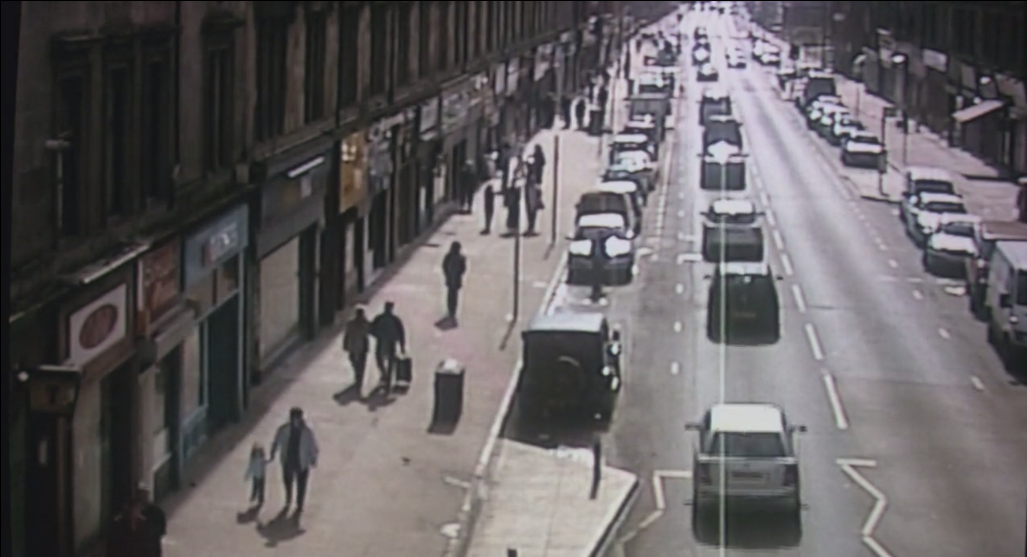
Fig. 1 Screengrab from Red Road
Other parts of the film, in an effort to be in line with the Dogme movement, were filmed on hand-held cameras or had a set up attached to a vehicle in motion, so that in parts actor’s were not aware of where the camera was (Thomson, 2007). It can be seen that this added to the authenticity of the film hence making it more believable for the viewer. Arnold contextualised these CCTV shots with a multiplicity of subjective shots, following the protagonists view not only in the streets, but also focusing on the painterly quality close ups on the screens. This juxtapositioning of filmic devices played into the believability of the film, as it was essential to creating an intimacy for the viewer (Murray & Arnold, 2016).

As it is not until the very end of the film that the purpose of the protagonist’s motivation is exposed, the audience is left questioning for the majority of the film. In waiting to reveal the key to the narrative, Arnold is able to create a power dichotomy unfamiliar in most surveillance films in the genre. Red Road subverts the role of the victim for most of the film; “reversing the traditional power dynamics of looking” (Lake, 2010). Challenging the conventional surveillance genre through a gendered lense, destabilizes the viewer’s expectations.
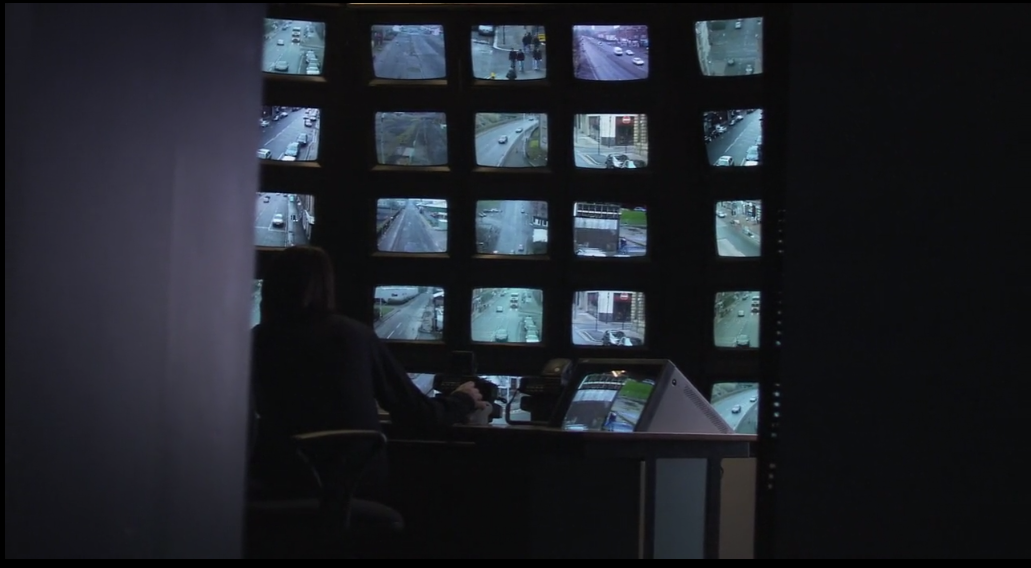
Fig. 3 Screengrab from Red Road
References:
Lake, Jessica. “Red Road (2006) and Emerging Narratives of ‘Sub-Veillance.’” Continuum, vol. 24, no. 2, 2010, pp. 231–240.
Murray, Jonathan, and Arnold, Andrea. “Red Roads from Realism: Theorising Relationships between Technique and Theme in the Cinema of Andrea Arnold.” Journal of British Cinema and Television, xiii, no. 1, 2016, pp. 195–213.
Thomson, Patricia, and Arnold, Andrea. “Red Road.” American Cinematographer, lxxxviii, no. 4, 2007, pp. 96-100.
 Surveillance: not even the cinema is safe